
What is the EDI 204 - Motor Carrier Load Tender?
The EDI 204, also known as a Motor Carrier Load Tender, is an EDI document used by shippers to offer, or tender, a truckload or less-than-truckload shipment to a carrier. A shipper can be a manufacturer, distribution center, or retailer. Carriers generally provide freight services and may be package carriers (e.g., FedEx) or common carriers (e.g., FedEx Freight, UPS, UPS Freight). The structure of the EDI 204 follows the ASC X12 standard maintained by the Accredited Standards Committee X12 under ANSI in 1979.
The Motor Carrier Load Tender (204) business message can also be used to facilitate communication between the shipper and a third party that provides freight and or freight payment services. When PartnerLinQ uses Motor Carrier Load Tender (204) business message in a freight payment scenario, it is expected that the freight payment service will transmit a Payment Order/Remittance Advice (820) back to PartnerLinQ for delivery to the origin/carrier.
How does PartnerLinQ use the EDI 204 - Motor Carrier Load Tender? 
PartnerLinQ uses the Motor Carrier Load Tender (204) to tender shipments to truckload motor carriers. The Load Tender contains shipment details including origin, destination, purchase order, and other tracking information. It also provides bill of lading, rating, and scheduling information and can serve as a legal bill of lading between shipper and carrier. When sent by a retailer, it acts as a pick-up notification.
What responses to the EDI 204 - Motor Carrier Load Tender are expected/sent?
The EDI 204 works in conjunction with the Response to a Load Tender (990), which carriers use to accept or reject loads. Functional Acknowledgments (997) an industry best practice are also used typically sent within 24 hours to confirm receipt and syntax validation. Messages with errors may be accepted with warnings or rejected and must be corrected and resent. PartnerLinQ reconciles the Response to a Load Tender (990) for every EDI 204 sent to ensure consistency and customer (shipper) satisfaction.
Shippers typically require a Response to a Load Tender (990) indicating acceptance or rejection of the load. The response must be received by the 'Must Respond by Date,' often a contractually defined time window. Without a timely response, loads may be cancelled or reassigned. The carrier responds to the Load Tender (204) with a Response to a Load Tender (990) noting acceptance or rejection of the load. When the time to respond, determined by the sender, has elapsed and there has been no response from the carrier the sender may, at their discretion, reject the load for the carrier sending a cancellation notification in Load Tender (204) indicated by the B2A01 Transaction Set Purpose where the B2A Transaction Set Purpose = 01 Cancellation.
What does the EDI 204 - Motor Carrier Load Tender support?
The Motor Carrier Load Tender (204) supports  transportation and logistics operations by providing carriers with the details necessary to plan, schedule, and confirm freight movements. It also supports downstream EDI messages such as the 210 Motor Carrier Freight Details and Invoice and the 214 Transportation Carrier Shipment Status, ensuring visibility, accuracy, and efficiency across the supply chain.
The use of the Motor Carrier Load Tender (204) business message generally improves shipment planning for both shippers and carriers, provides more accurate data in the Motor Carrier Freight Details and Invoice (210) message, and more accurate detail in the Transportation Carrier Shipment Status Message (214). The use of the Motor Carrier Load Tender (204) business message also serves to eliminate manual data entry errors by parties to the transaction which may be multiple.
What are the Key Features of the EDI 204 - Motor Carrier Load Tender?
The EDI 204 - Motor Carrier Load Tender:
- Provides shipment details (origin, destination, equipment, schedule
- Acts as a legal bill of lading when required
- Supports tender acceptance/rejection workflow with EDI 990
- Enables downstream integration with invoices (210) and shipment status (214)
- Reduces manual data entry errors by standardizing tender details
What is the Purpose the EDI 204 - Motor Carrier Load Tender?
The purpose of the EDI 204 is to electronically tender shipments to motor carriers, including truckload carriers. It communicates shipment, equipment, and scheduling details in a structured format, eliminating the need for paper-based tenders and reducing delays in freight execution.
What Information is Included in the EDI 204 - Motor Carrier Load Tender?
The EDI 204 communicates a shipment tender from a shipper, broker, or 3PL to a motor carrier. It outlines all shipment details required for acceptance, planning, and execution.
| Information Category | Description / What’s Included | Primary Segment(s) |
|---|---|---|
| Transaction Control Information | Transaction set header, control numbers, version IDs. | ST, B2, B2A, SE |
| Load / Shipment Identification | Load tender number, shipment number, BOL, reference IDs, SCAC. | B2, B2A, L11 |
| Shipper, Consignee & Parties | Name, address, shipper, consignee, bill-to, carrier, facility details. | N1, N2, N3, N4, PER |
| Geographic & Routing Information | Origin/destination, routing sequences, intermediary stops. | S5 Loop, N1 Loop, G62 |
| Dates & Times | Pickup/delivery dates, time windows, appointments. | G62, DTM |
| Equipment Details | Equipment type, size, trailer numbers, seals, temperature set points. | AT5, N7, W09 |
| Commodity & Line Item Details | Commodity descriptions, NMFC codes, freight class, handling units. | L5, H1, H2, L0, L1 |
| Weight, Volume & Metrics | Total weight, cube, units, pallets, load dimensions. | L0, L1, W09 |
| Rates, Charges, & Payment Terms | Base rate, fuel charges, accessorial rating, freight terms. | CD3, AT8, L3 |
| Hazardous Materials | Hazmat indicator, UN/NA codes, contact and emergency info. | H1, H2, PER |
| Accessorial / Special Services | Lumper, liftgate, inside delivery, security requirements. | L11, AT8, NTE |
| Special Handling Instructions | NTE remarks, loading instructions, temperature controls. | NTE, AT5 |
| Contact Information | Dispatch contacts, phone numbers, emails. | G61 |
| Stop-off Information | Multiple pickups/deliveries, stop sequences, stop windows. | S5 Loop, N1/N3/N4, G62 |
| Carrier Response Requirements | Acknowledgment expectations (e.g., via EDI 990). | L11, NTE |
| EDI Compliance & Control Segments | Control total, closing of transaction set. | SE |
What are the Essential Components of the EDI 204 - Motor Carrier Load Tender?
Essential components of the EDI 204 include the Shipment Identification Number (SID), shipper and consignee information, pickup and delivery windows, carrier SCAC, shipment method of payment, equipment requirements, lading details, and special instructions (NTE), components that allow carriers to evaluate tenders accurately.
What are the Common Segments Included in the EDI 204 - Motor Carrier Load Tender?
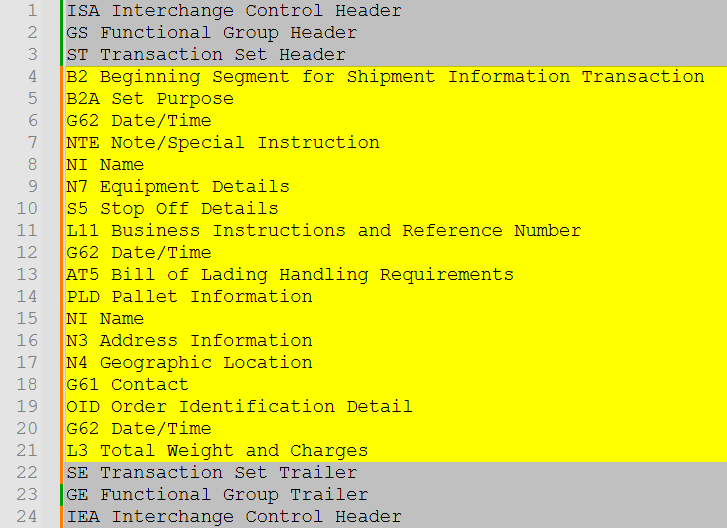
Commonly used segments in the EDI 204 include:
| Segment | Purpose / Information Carried |
|---|---|
| ST – Transaction Set Header | Starts the EDI 204; identifies transaction type and control numbers. |
| B2 – Beginning Segment for Shipment Information | Identifies shipper, carrier, SCAC, shipment ID, and transportation terms. |
| B2A – Set Purpose | Indicates purpose of the load tender (e.g., original, cancellation, update). |
| L11 – Business Instructions & Reference Numbers | Multiple reference numbers: PRO, BOL, load number, customer reference IDs. |
| G62 – Date/Time | Pickup and delivery dates/times; earliest/latest windows. |
| MS3 – Interline Information | Provides details about interline carrier arrangements when the shipment involves multiple carriers. |
| AT5 – Bill of Lading Handling Requirements | Special handling, temperature, load blocking/bracing, protective services. |
| PLD – Pallet Information | Details about pallets used in the shipment, including number of pallets, pallet type, and weight. |
| N1 – Party Identification | Identifies parties (shipper, consignee, broker, carrier, bill-to, etc.). |
| N3 – Address Information | Street address. |
| N4 – Geographic Location | City, state, ZIP, country. |
| N7 – Equipment Details | Trailer number, tractor number, equipment ID. |
| S5 – Stop Off Details | Indicates the origin location with each stop incrementing by 1 (1, 2, 3, etc.). |
| SE – Transaction Set Trailer | Ends the EDI 204; contains segment count and control number. |
What Status Codes are used with the EDI 204 - Motor Carrier Load Tender?
The B2A Transaction Set Purpose Code  segment is used to indicate the intent of the document, such as whether it is an original load tender, a replacement, a cancellation, perhaps even an update. The actual status, indicated by the B2A01 Transaction Set Purpose helps the carrier understand the action required for the load tender generally improving shipment planning for both shippers and carriers
The B2A01 Transaction Set Purpose Code conveys status such as:
- 00: Original
- 01: Cancellation
- 04: Change
- 06: Confirmation
Additionally, the G62 Date/Time segment is used to specify processing dates/time for example a G6201 with qualifier 64 indicates a 'Must Respond By' deadlines for carriers, a status change indicator which might be considered by a downstream operation during integration.
What Reason Codes are used with the EDI 204 - Motor Carrier Load Tender?
Reason codes in the EDI 204 are often embedded within reference numbers, response transactions (e.g., 990) or other fields such as the G62 Date/Time segment. They communicate acceptance, rejection, or cancellation, they also support reasons for cancellation or aid in supporting contractual obligations, audit, and dispute resolution and for that reason it is important to understand the inferences included within a transaction such as the EDI 204 - Motor Carrier Load Tender.
What Use Cases does the EDI 204 - Motor Carrier Load Tender support?
Common use cases for the EDI 204 - Motor Carrier Load Tender include:
- Retailers tendering loads to carriers for pickup
- Shippers providing detailed scheduling and equipment needs
- Brokers coordinating shipments between multiple carriers
- Carriers receiving early notifications for load planning
What are the Benefits of the EDI 204 - Motor Carrier Load Tender?
Benefits from using the EDI 204 - Motor Carrier Load Tender include:
- Improved shipment planning and carrier acceptance rates
- Improved deliveries to end points
- Reduced manual errors and processing delays
- Increased compliance with contractual response times
- Improved data structures for invoicing (210) and shipment status (214)
How efficient is the EDI 204 - Motor Carrier Load Tender?
The EDI 204 - Motor Carrier Load Tender speeds up decision-making for carriers and shippers and then continues to provide efficiencies in tracking not to mention asset traceability.
How Compliant is the EDI 204 - Motor Carrier Load Tender?
 The EDI 204 - Motor Carrier Load Tender meets industry requirements for truckload, intermodal, terminal, and logistics partners.
What is the Format of the EDI 204 - Motor Carrier Load Tender?
The EDI 204 - Motor Carrier Load Tender follows ASC X12 EDI formatting rules, with defined segments and delimiters, and generally meets most requirements for partners in the truckload, intermodal, or terminal-based logistics space.
How accurate is the EDI 204 - Motor Carrier Load Tender?
The EDI 204 - Motor Carrier Load Tender goes a long way to standardize shipment tenders, ensuring consistent reporting, reducing disputes, and improving key data exchange which leads to consistent, and as a consequence, more accurate reporting.
What are the Limitations of the EDI 204 - Motor Carrier Load Tender?
The 204 does not apply to less-than-truckload (LTL) bills of lading, pickup notifications, or manifests and it does requires trading partners to align on response timing and reference numbers for more effective use.
Are Guidelines & Sample Files for the EDI 204 - Motor Carrier Load Tender available?
Yes. PartnerLinQ provides sample EDI 204 - Motor Carrier Load Tender transaction and implementation guides through its Support and Guideline Management Team. Sample EDI 204 implementation guides illustrate both inbound and outbound flows, segment layouts, valid data examples, and support testing and partner onboarding. Customized specification documents for use in on boarding and technical development are available upon request. PartnerLinQ provides: EDI 204 - Motor Carrier Load Tender transaction implementation guide Sample payloads Qualification and testing maps Error handling and best-practice notes.
Contact our experts
What are the Basic Questions for EDI Integration of the EDI 204 - Motor Carrier Load Tender?
Key integration questions for the EDI 204 include:
- Are there Samples and Specs available?
- What is the general direction of the transaction?
- Are they Inbound to the client or Outbound from the client to another party?
- Are there more than one trading partner exchanging the EDI 204 - Motor Carrier Load Tender?
- Are there other interested parties?
- What other transactions might these interested parties be a party to?
- What response to the EDI 204 - Motor Carrier Load Tender transaction is expected or sent?
- Is a response to the transaction a timed event?
- How is response timing managed (G62)?
- Are notifications involved/needed?
- How are changes to the EDI 204 - Motor Carrier Load Tender managed?
- How are cancellations, confirmations, and changes handled (B2A01)?
- Is there automation? (an internal systems trigger) Or are the EDI 204 - Motor Carrier Load Tenders triggered manually?
- Are responses and changes automatically triggered? (an internal systems trigger) Or do transactions require human intervention?
- Are SCAC codes included, corrected, validated, or confirmed?
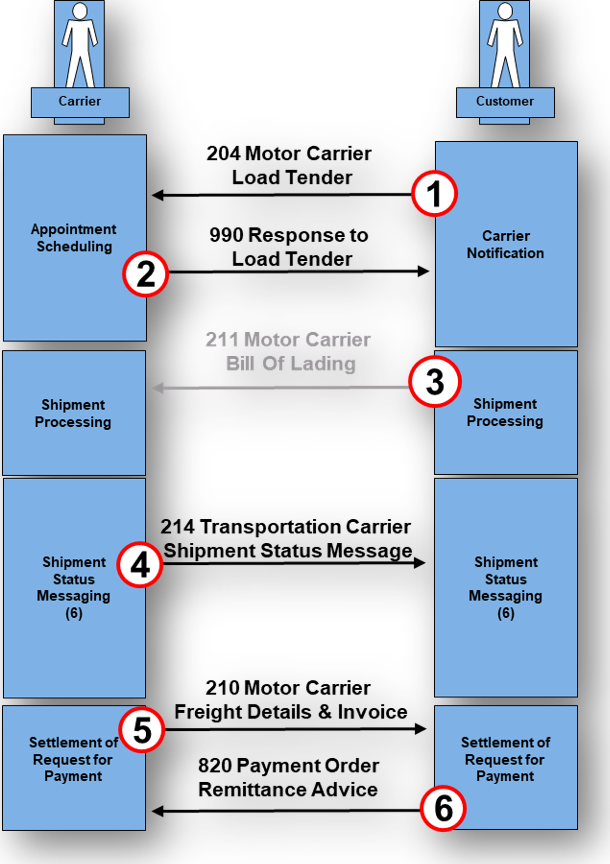
What Business Level Workflow does the EDI 204 - Motor Carrier Load Tender support?
- Shipper creates shipment in TMS/ERP.
- Shipper (system) generates EDI 204 with shipment details.
- Carrier receives and reviews tender.
- Carrier responds with EDI 990 acceptance/rejection.
- If accepted, shipment proceeds to execution (pickup, transport, delivery).
- Shipment status updates provided via EDI 214.
- Freight invoice issued via EDI 210
What are the Best Practices for using the EDI 204 - Motor Carrier Load Tender?
- Always include a unique Shipment Identification Number (SID).
- Ensure SCAC codes are validated and current.
- Use 'Must Respond By' G62 segments to avoid delays.
- Provide complete stop-off and equipment details.
- Confirm that 997 acknowledgments are exchanged promptly
What Transactions are associated with the EDI 204 - Motor Carrier Load Tender?
| Transaction | Name | Purpose / Relationship to the 204 |
|---|---|---|
| EDI 210 | Motor Carrier Freight Details and Invoice | Carrier invoice after delivery—tied to the 204 because rating and line-haul details often originate from the tender. |
| EDI 211 | Motor Carrier Bill of Lading | Sometimes issued after acceptance of the tender; provides BOL-specific details. |
| EDI 214 | Transportation Carrier Shipment Status Message | Communicates pickup, in-transit, delay, and delivery status updates once the 204 tender is accepted and the load is in motion. |
| EDI 215 | Motor Carrier Pick-up Manifest | Supports dispatch operations; may be generated after the 204 to prepare the driver’s pickup manifest. |
| EDI 301 | Confirmation / Booking Details for Ocean | In multimodal workflows, the 204 may coexist with ocean or rail bookings; included here for completeness. |
| EDI 820 | Payment Order/Remittance Advice | Used when the 210 invoice is paid. Not directly tied to the tender but part of downstream settlement. |
| EDI 824 | Application Advice | Communicates issues in the 204 content (e.g., incorrect data)—less common but used where trading partners enforce validation at tender time. |
| EDI 990 | Response to a Load Tender | Carrier accepts, rejects, or conditionally accepts the EDI 204 tender. This is the direct response transaction. |
| EDI 997 / 999 | Functional Acknowledgment / Implementation Acknowledgment | Confirms receipt and syntactical integrity of the 204 (not acceptance). |


Explore Our Integration Solutions

PartnerLinQ Integration Solutions
Connect Everything. Integrate Intelligently.
Future-Proof Your Business with Composable, AI Powered Connectivity.